
On this foreboding day in history, I was heartened by the #bridgesnotwalls campaign that was making itself seen and heard along London’s bridges and across the Twitterscape. Inspired to share in the collective expressions of freedom and inclusion, I immediately wondered what bridges had been built by book illustrators. That is, after all, what this occasional blog is supposed to be about. The first bridge that I stumbled across (as it were), which got my juices running, was not from a children’s book but from a remarkable series of London artworks by the wonderful Peter Jackson. Ironically, I found it on the Internet, when all along it was staring me in the face: I have it hanging on my wall. Peter’s extraordinary reconstruction shows London Bridge c.1600, with the ferociously flowing Thames whipping boats towards its pontoons, and the many grandiose Elizabethan buildings piled precariously upon its back. Take your pick from any number of metaphors for our modern world right there. With Peter, you know that what you are seeing is historically correct. He was not only a wonderful illustrator but one of the great historians and collectors of London ephemera. He scoured the city’s markets and second-hand shops to gather up over 25,000 prints. Between 1949 and 1980, Peter drew historical cartoon strips of London for the London Evening News, and he built up an unrivalled knowledge of the city’s history, beautifully conveyed through his work in a number of authoritative and evocative books.
Peter was a friend of my father’s, and his London Bridge led me across to another bridge very close to home. What better than a dragon’s tail for making a bridge when you’re on a dragon hunt and can’t see for looking, as illustrated by Richard Hook in our children’s book Where’s the Dragon? It’s funny how when you start looking, you can find bridges right beneath your nose, within your own four walls.

 That dragon-tail bridge carried me back in time to my childhood, as I started thinking about my favourite bridge from a children’s story. Surely, it must be the bridge in the Three Billy-Goats Gruff, with a hungry troll lurking beneath its humped back in wait for delicious goat flesh. The story originates in a Norwegian folk-tale, and has a classic narrative structure of three heroes moving from danger to safety by outwitting a threatening presence. In case you’ve forgotten it, the smallest and medium billy-goats succeed in crossing the bridge by each promising the troll a larger prize coming along behind, with the sumptuous finale of the third and biggest goat being of sufficient size and sharpness of horns to give the troll its just desserts. It’s an idea to make any writer or artist salivate, and I’d offer a bridge to any illustrator who would like to join me in a retelling.
I am instantly transported to my childhood when I see the splendidly realistic cover of the Ladybird version of the story, where both bridge and troll lurk unseen. I also discovered a beautiful early illustration from A Selection From The Norse Tales For The Use Of Children (Edinbugh, 1862) in Barbara Hawes’ excellent British Library blog, which gives a fascinating summary of the history of the tale and how it crossed over into our language.
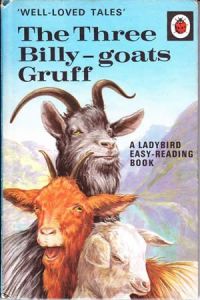 On a day such as this day, when #bridgesnotwalls lifted me up, it seems appropriate to celebrate three satiric heroes crossing safely over a bridge beneath which a troll will always lurk in the darkness.
Do you have any bridges from children’s literature that you’d like to share with me?

 I was struck, last night, by the way in which the BBC’s magnificent production of War and Peace drifted in Episode 4 into what felt suddenly like a fairy tale. The previous week, Natasha Rostova had gone like Cinderella to the ball and fallen in love with her Prince Andrei Bolkonsky (resplendent in tight-fitting uniform and gold braid, in contrast to the tragic observer Pierre Bezukhov whose outfits always appear two sizes too big) in a suitably enchanted dance sequence.
 Jason Hook Books